Do the Peptides in Your Skincare Actually Get In? The Penetration Problem the Marketing Skips, Decoded Peptide by Peptide

This article is for general informational and educational purposes only and is not medical or dermatological advice. Topical peptides are regulated in Canada and the US as cosmetic ingredients, individual results vary, and you should consult a dermatologist or qualified professional for concerns about your skin or before starting a new regimen.
Every peptide serum makes the same promise in roughly the same words: peptides “signal your skin to produce more collagen and elastin.” It is on the brand pages, the derm explainers, the back of the bottle. And it is true, as far as it goes. But it quietly skips the question that actually determines whether any of it matters, which is whether the peptide in that bottle ever reaches the living skin where that signaling would have to happen. Your skin’s outermost layer, the stratum corneum, is not a passive surface. It is an evolved barrier whose entire job is to keep foreign molecules out, and it is especially good at blocking exactly the kind of molecules most peptides are: relatively large and water-loving. Dermatology and pharmaceutical literature lean on a rough heuristic called the “500 Dalton rule,” the observation that molecules much above 500 daltons struggle to cross the stratum corneum, particularly hydrophilic ones. Matrixyl, one of the most studied and widely used cosmetic peptides, weighs about 802 daltons. Argireline, the one marketed as “topical Botox,” is hydrophilic and, in at least one FDA-funded study, did not penetrate beyond the most superficial skin layers from a cosmetic formulation. This is the part the “signals your skin” framing leaves out: a signal that never reaches the receiver is not a signal at all. None of this means topical peptides are useless, some have real evidence and clever workarounds exist, but it means the interesting and decision-relevant question is delivery, not just biology. This article covers what the popular explainers cover, what peptides are, the main types, the headline ingredients, and then builds the layer almost all of them skip: whether and how these molecules actually get where they need to go, which ones have evidence behind the penetration claim, and how a reader should weigh a peptide product accordingly. It also keeps topical skincare peptides clearly distinct from the injectable and ingestible peptides that dominate the rest of the “peptide” conversation, because they are different categories with different rules.
Why penetration, not signaling, is the question that decides everything
The standard framing treats a topical peptide like a key: it fits a receptor, triggers collagen production, done. But that framing assumes the key reaches the lock, and for skin that assumption is the whole ballgame. Peptides that act on fibroblasts or other targets need to get past the stratum corneum and into the viable epidermis or dermis to do anything beyond sitting on the surface. If a peptide cannot cross that barrier in a meaningful amount, then no matter how elegant its receptor biology, its real-world effect on your skin is limited to whatever it can do at the surface, which for a deep-acting signal peptide is very little.
This reframes how to read a peptide product. The relevant questions stop being only “what does this peptide do in a petri dish” and become “is this specific peptide, in this specific formulation, capable of getting in, and is there evidence it does.” That is a harder and more honest question, and it explains why two products with the same headline peptide can perform completely differently: the difference is often in the molecular modifications and the delivery vehicle, not the peptide name on the label. Even a careful, dermatologist-sourced overview like Cleveland Clinic’s notes that simply having peptides in a product does not make them effective, and that the cosmetic chemistry of getting the most out of them can be tricky, a polite gesture at the penetration and formulation problem this article makes central.
What an honest peptide-skincare guide has to cover
A guide that respects the reader has to work on several layers. There is the basic biology: what peptides are and the main functional types. There is the penetration question: the barrier, the size and charge problem, and the workarounds, which is the layer the marketing skips. There is the evidence layer, graded by individual peptide rather than lumped together, because Matrixyl, GHK-Cu, and Argireline have very different evidence profiles. There is the formulation-and-routine layer: why the vehicle and even the order of application matter. And there is the regulatory and category layer: that topical cosmetic peptides are governed as cosmetics, and are a different thing from the injectable and ingestible peptides people also call “peptides.” The credible explainers do the biology and a bit of the evidence layer; the brand pages do biology and product. Almost none develop the penetration layer with any specificity, which is exactly where a reader’s money and expectations are most often misplaced.
The peptide types, briefly and accurately
Cosmetic peptides are usually grouped by what they are meant to do, and getting the categories straight makes the rest of the article legible. Signal peptides, the most common anti-aging type, are meant to mimic fragments of broken-down collagen, tricking the skin into thinking it needs to produce more; Matrixyl (palmitoyl pentapeptide-4) is the archetype. Carrier peptides ferry a trace mineral the skin needs into tissue; the copper tripeptide GHK-Cu is the classic example, delivering copper that supports enzymes involved in collagen cross-linking and antioxidant defense. Enzyme-inhibitor peptides aim to slow the breakdown of existing collagen. Neurotransmitter-inhibitor peptides, the “Botox-like” category, aim to reduce the muscle micro-contractions that deepen expression lines; Argireline (acetyl hexapeptide-3, also sold as acetyl hexapeptide-8) is the headline name.
These categories are real and useful, but they describe intended mechanism, not guaranteed effect, and crucially they say nothing about whether the peptide gets into the skin. A signal peptide that cannot reach fibroblasts and a neurotransmitter-inhibitor peptide that cannot reach the neuromuscular junction are both, in practical terms, surface ingredients regardless of their category label. The taxonomy tells you what a peptide is trying to do; the penetration question tells you whether it can.
The barrier problem: the 500 Dalton rule and why peptides struggle
Here is the science the brand pages avoid. The stratum corneum is built from densely packed dead, flattened cells and lipid layers, and it is impermeable to most molecules above roughly 500 daltons, especially hydrophilic ones. This “500 Dalton rule” is a rule of thumb, not a hard cutoff, but it captures a real constraint repeatedly documented in the transdermal-delivery literature: getting peptides through intact skin is genuinely difficult because they tend to be both too large and too water-loving. The skin is doing precisely what it evolved to do, keeping foreign matter out.
This is why so many cosmetic peptides are chemically modified or specially delivered. The single most common trick is lipidation, attaching a fatty-acid tail (often a palmitoyl group) to make the peptide more lipophilic so it can slip through the lipid-rich barrier. This is why you see “palmitoyl” in front of so many cosmetic peptide names. The evidence that this works is concrete: a 2014 study found that palmitoylated KTTKS (pal-KTTKS, the molecule in Matrixyl) distributed across all skin layers, while the unmodified KTTKS was undetectable, the fatty tail made the difference between getting in and not. Beyond lipidation, formulators use liposomes and other nanocarriers, positively charged residues, and physical methods like microneedling or iontophoresis to improve delivery. The practical lesson is blunt: the delivery vehicle and the molecular modification can matter as much as, or more than, the peptide itself. A peptide is only as good as its ability to arrive.
Grading the headline peptides by what the evidence actually shows
Because the categories and the penetration question interact, the only honest way to assess cosmetic peptides is one at a time. The three most prominent illustrate the full range.
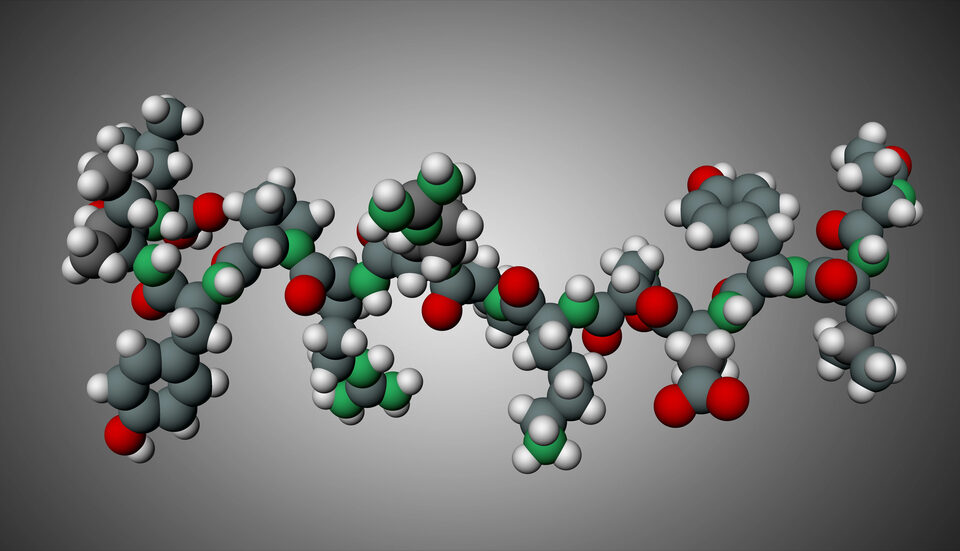
Matrixyl (palmitoyl pentapeptide-4 / pal-KTTKS) has the strongest evidence of the common cosmetic peptides. It is a signal peptide, and multiple double-blind, placebo-controlled trials support a wrinkle-reducing effect, including a 12-week split-face study showing benefit at a 3 ppm concentration in a moisturizer. On penetration specifically, it weighs about 802 daltons, above the ideal range, but its palmitoyl modification improves lipophilicity, and a 2021 imaging study using a technique called OrbiSIMS physically detected Matrixyl peptides at least 13 cell layers into the stratum corneum. So Matrixyl is the case where the penetration claim is best supported and the clinical evidence is real, though some of that evidence carries industry-funding caveats worth noting.
GHK-Cu (copper tripeptide-1) is a carrier peptide with substantial mechanistic depth in the research literature, activating enzymes like lysyl oxidase involved in collagen and elastin cross-linking, and some clinical signals for elasticity. Its evidence is more mechanistic and less standardized in consumer-product clinical outcomes than Matrixyl’s, so it sits in a “biologically interesting, clinically promising, less definitively proven in finished products” zone.
Argireline (acetyl hexapeptide-3/8) is the cautionary case. It is marketed as “topical Botox” on the theory that it inhibits the neurotransmitter signaling that drives expression lines. The problem is delivery: it is hydrophilic, and a 2015 FDA-funded study found that acetyl hexapeptide-8 did not penetrate beyond the most superficial skin layers from a cosmetic formulation. Botox, by contrast, is an injectable that bypasses the barrier entirely and acts at much higher potency directly at the target. Comparing a poorly penetrating topical to an injected neurotoxin is, as researchers have put it, scientifically unsupported. Argireline may produce mild surface effects, but the “topical Botox” framing oversells both its penetration and its potency.
| Peptide | Type | Penetration reality | Evidence profile |
|---|---|---|---|
| Matrixyl (pal-KTTKS) | Signal | ~802 Da but palmitoylated; detected layers into stratum corneum | Strongest; multiple placebo-controlled trials (some industry-funded) |
| GHK-Cu (copper tripeptide-1) | Carrier | Small tripeptide; penetrates relatively well | Strong mechanism; less standardized finished-product outcome data |
| Argireline (acetyl hexapeptide-3/8) | Neurotransmitter-inhibitor | Hydrophilic; FDA-funded study found little penetration beyond surface | “Topical Botox” claim unsupported; mild surface effects at best |
Why formulation and even application order matter
Once you accept that delivery is the crux, several practical things follow that the “just buy a peptide serum” framing misses. First, concentration and vehicle matter: a peptide present at a token amount, or suspended in a formulation that does not aid penetration, may do little regardless of the peptide’s theoretical potency. Second, the order you apply products can affect how much peptide reaches its target, because each layer can interfere with the next. The general logic that some formulators and researchers describe is to apply the deepest-acting, best-penetrating peptides first on clean skin, then layer medium-penetration structural peptides, and apply surface-acting peptides last, since a peptide that acts near the surface does not need to fight through everything above it. Whether a given routine achieves meaningful differences is product-specific, but the underlying point is sound: a peptide’s effect is contingent on the conditions of its delivery, not just its presence in the lineup.
This is also why peptides are usually best understood as one component of a regimen rather than a magic bullet. The dermatology consensus, even from peptide-favorable sources, is that the foundation of skin care remains cleansing, moisturizing, and sun protection, and that well-established actives like retinoids and hyaluronic acid have strong evidence and are often less expensive. Peptides can be a worthwhile addition, particularly well-delivered signal peptides like Matrixyl, but they are an optional layer on a proven base, not a replacement for it.
A scenario: problem, cause, solution, outcome
The problem. Take someone who bought an expensive “peptide” eye cream specifically for its Argireline content, expecting a visible “topical Botox” softening of frown lines, and is disappointed after two months of diligent use.
The cause. The product’s marketing borrowed the credibility of injectable neuromodulators, but the peptide is hydrophilic and penetrates poorly from a topical formulation, and topical Argireline acts at a fraction of an injection’s potency even when some reaches its target. The “topical Botox” framing set an expectation the delivery reality could not meet, and nothing in the marketing addressed penetration at all.
The solution. They reorient around delivery and evidence. They recognize that the strongest-evidence cosmetic peptide for wrinkles is a well-delivered signal peptide like Matrixyl, that molecular modification (the palmitoyl tail) and the formulation vehicle matter as much as the peptide name, and that for expression lines specifically, a topical peptide is not equivalent to an injectable. They reset expectations toward gradual firmness and fine-line improvement over months rather than a Botox-like result, and they keep peptides as one layer on a base of sunscreen, moisturizer, and possibly a retinoid.
The outcome. Their spending and expectations realign with what topical peptides can actually do. If they want a genuine neuromodulator effect, they understand that is a clinical, injectable conversation, not a serum; and if they continue with peptides, they choose products on penetration-relevant features and evidence rather than on a borrowed comparison to an injection.
Topical peptides are not injectable or ingestible peptides
One clarification prevents a great deal of confusion, because the word “peptide” now spans wildly different products. Topical cosmetic peptides, the subject of this article, are applied to the skin’s surface and are regulated as cosmetic ingredients; their central challenge is penetrating the skin barrier, and their claims are cosmetic, improving appearance, not treating disease. These are a separate world from the injectable research peptides marketed for muscle, recovery, or fat loss, which are generally regulated as drugs and which Health Canada has warned against in unauthorized form, and from ingestible collagen peptides, which are swallowed and regulated as natural health products. A copper peptide in a serum and a copper peptide in an injectable vial are governed by entirely different rules and raise entirely different questions, and conflating them, as casual “peptide” talk online often does, leads people badly astray. For the skincare reader, the relevant frame is cosmetics: appearance claims, surface or near-surface action, and a barrier to get past.
On the Canadian regulatory side, topical peptide products are sold as cosmetics, with the appearance-focused claims that category permits, distinct from the natural-health-product and drug frameworks that govern ingestible and injectable peptides respectively. General, non-commercial background on how cosmetic ingredients are regulated and labeled is available through resources such as the cosmetic-ingredient information published by the US Food and Drug Administration, useful for understanding why a cosmetic peptide can claim to improve the look of skin but not to treat a condition. Foundational dermatology background on skin structure and the barrier is available through references like the skin anatomy and physiology overview hosted in the NIH’s StatPearls collection, which makes clear why the stratum corneum is such a formidable obstacle for any topical active.
How to evaluate whether your peptide-skincare decision is sound
Run this diagnostic before buying or judging a peptide product.
- Does this peptide have any plausible way to actually penetrate the skin? Large, hydrophilic peptides struggle to cross the stratum corneum without modification or special delivery.
- Is the peptide lipidated or delivered in a penetration-enhancing vehicle? A “palmitoyl” prefix or liposomal/nanocarrier delivery is a meaningful signal.
- Am I judging the product by the peptide name or by the formulation? Two products with the same peptide can perform very differently based on delivery.
- Does the specific peptide have real clinical evidence? Matrixyl has the strongest; Argireline’s “topical Botox” claim is the weakest on penetration grounds.
- Am I treating a topical neurotransmitter-inhibitor peptide as equivalent to an injectable? A poorly penetrating topical is not comparable to an injected neuromodulator.
- Is this peptide an add-on to a proven base, or am I expecting it to replace fundamentals? Sunscreen, moisturizer, and retinoids remain the evidence-backed foundation.
- Have I set a realistic timeframe? Firmness and fine-line changes, if they occur, typically take weeks to a few months.
- Am I clear this is a topical cosmetic, not an injectable or ingestible peptide? They are different categories with different rules and different evidence.
For readers who encounter the same peptide names across very different product categories, it can be clarifying to see how a research-compound retailer such as NØX Peptides frames its catalog around research use, and how categories like the skin, tissue, and bone grouping within a Canadian research-peptide catalog are organized, while keeping firmly in mind that a topical cosmetic peptide in a serum is a fundamentally different product, with a different regulatory status, than a research compound, even when a shared name like a copper peptide appears in both worlds.
Frequently Asked Questions
Do peptides in skincare actually penetrate the skin?
It depends heavily on the specific peptide and how it is formulated. The skin’s outer barrier, the stratum corneum, blocks most molecules above roughly 500 daltons, especially water-loving ones, and many peptides are both large and hydrophilic, so plain peptides in simple aqueous formulas often penetrate poorly. Modifications like adding a fatty-acid (palmitoyl) tail measurably improve penetration, as shown by studies where palmitoylated pal-KTTKS distributed across skin layers while the unmodified version was undetectable, and delivery systems like liposomes help further. So some peptides do penetrate meaningfully, but the delivery vehicle and molecular modification matter as much as the peptide itself.
Which skincare peptide has the best evidence?
Among common cosmetic peptides, Matrixyl (palmitoyl pentapeptide-4, or pal-KTTKS) has the strongest evidence, with multiple double-blind, placebo-controlled trials supporting a wrinkle-reducing effect, including a 12-week split-face study at a 3 ppm concentration, and imaging studies have physically detected it penetrating into the stratum corneum. It is a signal peptide, meaning it prompts the skin to produce more collagen. Some of its supporting research carries industry-funding caveats, but it remains the best-supported of the widely used cosmetic peptides, with copper peptides (GHK-Cu) having strong mechanistic backing but less standardized finished-product outcome data.
Is Argireline really like topical Botox?
No, that comparison is not scientifically supported. Argireline (acetyl hexapeptide-3/8) is a topical peptide theorized to reduce expression lines by partially inhibiting neurotransmitter signaling, but a 2015 FDA-funded study found that acetyl hexapeptide-8 did not penetrate beyond the most superficial skin layers from a cosmetic formulation. Botox is an injectable that bypasses the skin barrier entirely and acts at much higher potency directly at the target tissue. So even setting potency aside, a topical that largely stays at the surface cannot be equated with an injected neuromodulator, and the “topical Botox” framing oversells both penetration and effect.
Why do some peptide names start with “palmitoyl”?
The “palmitoyl” prefix indicates the peptide has been attached to palmitic acid, a fatty acid, in a process called lipidation. This is done specifically to make the peptide more lipophilic, or oil-loving, so it can better cross the skin’s lipid-rich barrier, which otherwise blocks large, water-loving molecules. The modification has measurable effects on penetration, which is why palmitoylated peptides like pal-KTTKS (Matrixyl) are among the better-penetrating cosmetic peptides. When you see “palmitoyl” on a label, it is a reasonable signal that the formulator has addressed the penetration problem rather than ignored it.
Are peptides worth the higher price compared to other ingredients?
They can be, but they are not a required centerpiece. Dermatology guidance, even from peptide-favorable sources, holds that the foundation of skin care is cleansing, moisturizing, and sun protection, and that well-established and often cheaper actives like retinoids and hyaluronic acid have strong evidence for anti-aging benefits. A well-delivered signal peptide like Matrixyl can be a worthwhile addition, particularly for those wanting a gentler option, but peptides are best viewed as an optional layer on a proven base rather than a justification for an expensive routine. Whether the premium is worth it depends on the specific product’s formulation and your goals and budget.
How long do peptide skincare products take to work?
Realistic timelines are gradual. Some hydration benefits may be noticeable within days, but visible improvements in firmness and fine lines from peptides typically take roughly 4 to 8 weeks or more of consistent use, consistent with how long it takes for changes in collagen-related processes to manifest. This is one reason setting expectations matters: a peptide product is not going to produce an overnight or dramatic change, and judging it after only a few days is premature. Consistent daily use over a couple of months, alongside sun protection, is the reasonable window for assessing whether it is doing anything for you.
Are skincare peptides the same as the peptides people inject?
No, they are entirely different categories despite sharing the word “peptide.” Topical cosmetic peptides are applied to the skin surface, regulated as cosmetic ingredients, make appearance-based claims, and face the central challenge of penetrating the skin barrier. The injectable peptides marketed for muscle, recovery, or fat loss are generally regulated as drugs, and Health Canada has warned against unauthorized versions; ingestible collagen peptides are swallowed and regulated as natural health products. A copper peptide in a serum and a copper peptide in an injectable vial raise completely different safety, regulatory, and efficacy questions, so it is important not to let casual online “peptide” talk blur these together.
Can I use multiple peptides together, and does application order matter?
Multiple peptides can be used together and are often combined in multi-peptide formulas, since different peptides target different concerns and can be complementary. Application order can matter because each layer may affect how much of the next reaches its target; a common logic is to apply the deepest-penetrating peptides first on clean skin, then medium-penetration structural peptides, and surface-acting peptides last. Whether a particular routine produces meaningfully different results is product-specific, but the underlying principle, that delivery conditions affect outcomes, is sound. Layering peptides with hydrating ingredients like hyaluronic acid and following with sunscreen during the day is a reasonable general approach.
Important Disclaimers and Cosmetic Regulation Notes
This article is editorial and informational only and does not constitute medical or dermatological advice. Topical peptides discussed here are regulated as cosmetic ingredients in Canada and the US, make appearance-related rather than disease-treatment claims, and should not be confused with injectable research peptides (generally regulated as drugs, with Health Canada warning against unauthorized products) or ingestible collagen peptides (regulated as natural health products). Statements about benefits reflect a mixed and partly industry-funded body of cosmetic evidence rather than guaranteed outcomes, and nothing here is intended to diagnose, treat, cure, or prevent any disease or condition. Readers with specific skin concerns, sensitivities, or allergies should consult a dermatologist or qualified professional, patch-test new products, and follow product labelling and applicable Canadian federal and provincial requirements.